The Last Time The Beatles Felt Like The Beatles: Inside The Rooftop Concert That Closed An Era
January 30, 1969. Apple Corps headquarters, 3 Savile Row, London. The most famous band in the world climbs to the roof and plays rock and roll for the last time.
Luis Calleo
6/18/202614 min read
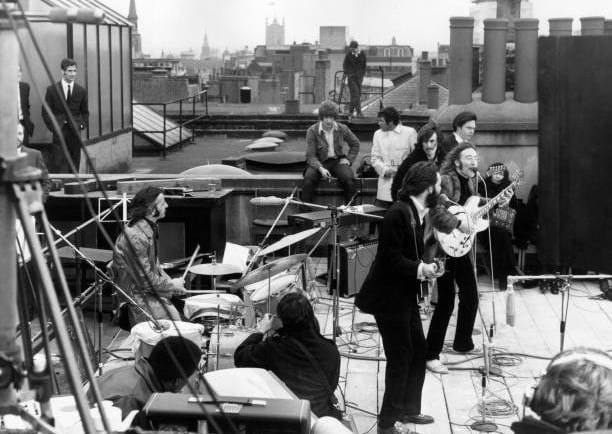
Photo by Express/Express/Getty Images
Introduction
The lunch crowd on Savile Row barely knew what was happening at first. The street was lined with tailors, the kind of establishments where quiet prevailed and appointments were kept. Then, just before noon, the sound hit — electric guitars, a driving backbeat, and a voice that London had heard a thousand times on the radio but never quite like this, unannounced, from above. Workers stopped. Office windows opened. A few people climbed onto rooftops across the street just to see. Down below, a police constable paused on the pavement and looked up.
For forty-two minutes on January 30, 1969, The Beatles were a rock and roll band again. It would be the last time.
The Weight of What Came Before
To understand what the rooftop concert meant, you have to understand what The Beatles had been carrying for the previous two years.
By early 1969, the group that had transformed popular music — that had gone from Beatlemania to Revolver to Sgt. Pepper's Lonely Hearts Club Band in a span of three years — was fraying at the edges in ways the public could only partially see. The deaths and departures had already begun. Brian Epstein, their manager since 1961 and the man who had shaped their early career and public image, died of an accidental overdose in August 1967. His loss removed one of the few people capable of mediating between four increasingly independent personalities, and the band had never found a satisfactory replacement.
Sgt. Pepper's, released in June 1967, was the peak — artistically revolutionary, commercially dominant, critically celebrated as few albums before or since. But peaks invite questions about what comes next, and for The Beatles, what came next was complicated. The Magical Mystery Tour television film, released at Christmas 1967, received a hostile critical reception in Britain. The White Album, recorded in the summer and autumn of 1968, was a sprawling double record that contained some of the most inventive music of any of their careers alongside signs of a group fracturing into four solo artists sharing studio time. George Martin, their producer since the beginning, later recalled that the White Album sessions were marked by an atmosphere of tension and creative detachment he had not previously experienced with the group.
The death of Epstein had also accelerated problems at Apple Corps, the company The Beatles had founded in 1968 with the idealistic but poorly planned ambition of creating a creative enterprise they would control. By early 1969, Apple was in financial disarray. Money was being mismanaged. The band was feuding — sometimes openly — over who should manage their affairs going forward. John Lennon and Paul McCartney had each developed strong and competing views on the subject. The tensions surrounding Apple were not just business problems; they reflected deeper disagreements about what The Beatles were and what they should become.
Ringo Starr had briefly walked out during the White Album sessions in August 1968, returning after two weeks. The cracks were visible.
The Get Back Idea
The project that would eventually produce both the Let It Be album and the rooftop concert began with a specific ambition: strip everything back.
In late 1968, Paul McCartney proposed that the band return to its rock and roll roots by rehearsing a set of new songs and performing them live in front of an audience — something The Beatles had not done since their final concert at Candlestick Park in San Francisco in August 1966. The idea was appealing in theory. After years of increasingly complex studio productions, there was a genuine desire among at least some members to reconnect with the directness and energy of live performance. The working title was Get Back, which captured the spirit of the project: strip away the orchestration, the studio artifice, the conceptual ambition, and get back to something essential.
The director chosen to film the rehearsals and ultimate performance was Michael Lindsay-Hogg, who had previously directed promotional films for the band and was a trusted collaborator. The plan was to document the process of creating a live concert, capturing the band in rehearsal and performance in a way that would be honest and revealing. It was, in some ways, a precursor to what would later be called the rockumentary.
What the project became was something considerably more turbulent.
Twickenham and the Unraveling
Rehearsals began at Twickenham Film Studios on January 2, 1969. The cameras rolled from the start. What they captured was not the joyful reunion of a great rock and roll band, but something more difficult and more human.
The atmosphere in the cavernous rehearsal space was strained from early on. The band was working in a large, cold studio under the constant presence of cameras and lighting equipment, which suited neither the intimacy the project required nor the creative process they had previously relied on. Songs were tried and abandoned. Tempers frayed. Conversations that might have stayed private in another context were captured on film.
The most dramatic event came on January 10. George Harrison, whose relationship with McCartney in particular had become increasingly difficult — Harrison felt his songwriting was not given adequate respect within the group — walked out. He announced at lunch that he was leaving the band. The cameras, still rolling, caught the aftermath: Lennon, McCartney, and Starr sitting in the studio, uncertain what had just happened or what it meant.
Harrison's departure lasted roughly a week. His return was negotiated, in part, through a compromise: the sessions would move from Twickenham to the basement studio at Apple Corps headquarters on Savile Row, which was being fitted out as a proper recording facility. The grand live concert plan was quietly shelved, at least in its original form. The question of where and whether the band would perform live remained unresolved.
The sessions at Apple, beginning in late January, were different in character. Keyboardist Billy Preston, a musician Harrison had known since the early 1960s when The Beatles had toured with Little Richard, was invited to join the sessions. Preston's presence — affable, musically gifted, unentangled in the personal dynamics — had a discernible effect on the atmosphere. The recordings from this period, later released in the Get Back documentary, show moments of genuine musical pleasure, the four members finding common ground in playing together. But the underlying tensions did not disappear.
The idea of a live performance had not died. Lindsay-Hogg had been pushing for something — a proper concert, ideally abroad, somewhere with scale and spectacle. An amphitheatre in Libya was suggested and rejected. A London venue was considered. The logistics of organizing anything significant in the available time were formidable. As January progressed and no clear plan emerged, an alternative began to take shape.
Forty-Two Minutes Above Savile Row
The rooftop was Mal Evans's suggestion — or at least, he was among those who championed it. Evans, The Beatles' longtime road manager and personal assistant, recognized that the flat roof of 3 Savile Row offered something available at virtually no notice: a stage, of a kind, in the open air, in the middle of London.
The band agreed. The equipment was assembled. On the morning of January 30, keyboards, amplifiers, and a drum kit were carried up through the building to the roof. The weather was cold — overcast and with a biting wind that would prove uncomfortable for all four musicians. Lennon borrowed his wife Yoko Ono's fur coat. McCartney played in his suit. Harrison wore a dark jacket and a red shirt. Starr, famously, wore a red mac that Ono had given him.
The set began at 12:02 PM. Glyn Johns, who was engineering the sessions, had set up microphones to record the performance. Lindsay-Hogg's cameras were positioned on the roof and on the street below.
What The Beatles played that afternoon was a distillation of what the Get Back sessions had been reaching toward: direct, unpolished, alive. They opened with "Get Back," the song that had become the working anthem of the entire project. They played "Don't Let Me Down," which Lennon had written for Ono and which carried an emotional directness unusual even for him. "I've Got a Feeling," a McCartney-Lennon collaboration that was actually two different songs stitched together, showcased how the two could still function creatively as a unit when the circumstances were right. "One After 909" was an early Lennon-McCartney number the band had written as teenagers, a piece of shared history that stretched all the way back to before their recording career. "Dig a Pony" was performed twice. "Get Back" was performed three times across the set, serving almost as a recurring theme.
The performance was not technically flawless. The cold affected tuning. There were moments of adjustment, of casual communication between the musicians, of the looseness that comes from playing live without rehearsal polish. But what the footage from that afternoon shows — and what The Beatles: Get Back documentary made viscerally clear when it was released in 2021 — is a band playing with evident enjoyment, with a freedom and looseness that had been conspicuously absent from much of what the cameras had captured at Twickenham. Lennon in particular seemed energized. Harrison played with focus and precision. McCartney's bass lines were characteristically melodic and assertive. Starr anchored everything with the steady, understated drumming that had always been the band's engine.
People on the street below, hearing the music, began to gather. Office workers emerged from buildings. Pedestrians stopped on the pavement, looking up, trying to locate the source of the sound. Someone recognized the voices. Word spread quickly. On nearby rooftops, small crowds assembled. The response was, by most contemporary accounts, a mixture of delight and bewilderment — not many Londoners on their lunch break in January 1969 expected to hear The Beatles playing live overhead.
The mood in the nearby offices was more divided. Several businesses on Savile Row and adjacent streets complained about the noise. It was, after all, the middle of a working day, and the disruption was genuine. The police were called.
The Police Arrive
The arrival of the Metropolitan Police was captured on film and has become one of the iconic images associated with the concert. Officers arrived at the building in response to complaints about noise. They entered the building, made their way upstairs, and came out onto the roof to speak to the band.
The interaction was notably measured. The officers who arrived were, by all accounts, not confrontational. They asked the band to turn down the volume. Roadie Mal Evans, stationed at the electrical control, reduced the power to the amplifiers at certain points during the latter part of the set. But the performance was not immediately halted.
The sequence of the police intervention in Let It Be — and later reimagined with full context in The Beatles: Get Back — has been subject to some mythologizing over the years. The reality was less dramatic than some accounts suggest: the police did not storm the roof and forcibly end the concert. What actually happened was a negotiation, a conversation between officers and band representatives, during which the performance continued.
It was McCartney who played on through much of this, seemingly enjoying the absurdity of the situation. And it was Lennon who, as the set drew toward its close, delivered the line that would become one of the most quoted in rock history.
"I'd Like to Say Thank You on Behalf of the Group"
The final song was "Get Back," the third and last full performance of it that afternoon. As it ended, the music faded and Lennon stepped to the microphone. His closing remarks were brief and deliberately underplayed: "I'd like to say thank you on behalf of the group and ourselves, and I hope we passed the audition."
It was classic Lennon — sardonic, deflating, perfectly pitched between sincerity and self-mockery. He was both acknowledging the absurdity of the entire situation and, in some reading, gesturing at the larger uncertainty surrounding the band. Had they passed? The rooftop concert had been organized in part because the original ambition of a proper live performance had proven impossible. They had, in the end, played on a roof in January with the police present and a small crowd below. Whether this was triumph or compromise depended on how you chose to see it.
The performance ended at approximately 12:44 PM.
Aftermath and the Road to Let It Be
The footage from the Get Back sessions was not immediately used. Glyn Johns prepared two versions of a proposed album in 1969, but both were rejected. The material sat, largely unused, for over a year.
Meanwhile, The Beatles recorded Abbey Road in the summer and autumn of 1969 — an album that, paradoxically, felt more like a final statement than Let It Be would. The tensions had not resolved. By late 1969, Lennon had privately told the others he was leaving. The public announcement of the breakup came in April 1970, when McCartney confirmed through a press release accompanying his solo album that he had left the group.
The Let It Be album and film, finally released in May 1970, arrived into a world already processing the end of The Beatles. The film, as cut by Lindsay-Hogg, presented a downbeat and at times painful picture of the sessions — the arguments, the silences, the creative frustration. The rooftop concert, which closed the film, offered a moment of catharsis after the difficulties that preceded it. But even that closing sequence was shadowed by context: here was the band playing live, yes, but on a rooftop, with police present, and the breakup already announced.
The Let It Be album, produced in its final form by Phil Spector after Lennon and Harrison brought him in over McCartney's objections, added orchestration and choral arrangements to several of the recordings. McCartney was furious. The dispute over the album's production became one of the final and most bitter points of contention between the members of the band.
Reassessment: The Beatles: Get Back
For decades, the narrative around the Get Back sessions was shaped almost entirely by the Let It Be film and the circumstances of the breakup. The sessions became synonymous with misery, dissolution, and creative exhaustion. The rooftop concert was understood as a brief, bittersweet flicker of the old chemistry before everything went dark.
Peter Jackson's The Beatles: Get Back, released on Disney+ in November 2021, fundamentally complicated that narrative. Jackson and his team had access to the full archive of filmed footage — approximately sixty hours of material — as well as high-quality audio recordings. What emerged from that archive was a portrait considerably more nuanced than anything Let It Be had suggested.
The new documentary showed, at length, what the Let It Be film had compressed or omitted: the actual musical pleasure the band experienced during portions of the sessions, the jokes and warmth between members, the moments of genuine creative collaboration, and — perhaps most strikingly — the degree to which songs were constructed almost spontaneously, working from almost nothing to something complete within hours or days. McCartney composing "Get Back" from a guitar riff in real time became one of the documentary's most discussed sequences.
The Beatles: Get Back also presented the rooftop concert in its fullest form — not the compressed version from the Let It Be film, but the complete performance, with the cameras cutting between the band on the roof, the crowd gathering below, and the police arriving and negotiating their way through the building. What this fuller version revealed was a performance that felt less like a final gasp and more like a genuine moment of musical aliveness.
The documentary did not erase the tensions that were real and documented. Harrison did walk out. The arguments were real. The business problems were real. But it restored a complexity to the story that fifty years of mythology had flattened. The Get Back sessions were difficult, but they were also, at moments, something better than that.
The Question of "Final Performance"
The rooftop concert is frequently described as The Beatles' last live performance, and in the most meaningful sense, it was. It was the last time all four members performed together in front of an audience — however unplanned and unconventional that audience was. It was the last time they played original material together in a public setting.
The caveat worth noting is that the band did subsequently record together. The sessions for Abbey Road in the summer of 1969 produced some of the finest music any of them had made. And in 1995 and 1996, the surviving three members — McCartney, Harrison, and Starr — completed two recordings begun by Lennon, "Free as a Bird" and "Real Love," for the Anthology project, using demo recordings Lennon had made before his death in 1980. These were studio collaborations, not live performances, and they belonged to a different era and context.
The August 1969 sessions also included a notable moment: on August 22, 1969, all four Beatles appeared at Tittenhurst Park, Lennon's country home, for a photo session with photographer Ethan Russell. It was the last time all four were in the same place together. But they were not performing.
So the rooftop concert holds its place as the last public performance, the last time The Beatles stood in the world and played together as a band in real time. That distinction matters.
Why It Endures
Part of what makes the rooftop concert so durable as a cultural moment is its accidental quality. There was no rehearsal for the performance itself. There was no stage design, no lighting rig, no ticket sales, no announcement. The audience was whoever happened to be on Savile Row at lunchtime on a Thursday in January. The police came. The cold was uncomfortable. The whole thing lasted less than an hour.
And yet.
The footage from the rooftop has a quality that most live performance footage lacks: it feels genuinely unguarded. The Beatles were not performing for fans who had bought tickets. They were not competing with any particular expectation. They were playing on a roof in the middle of London because it was the only viable option remaining, and because somewhere inside the accumulated tensions and business problems and creative conflicts, they were still musicians who knew how to play together.
The influence of the concert on subsequent music culture is traceable, if difficult to quantify precisely. The idea of an unannounced, unexpected performance in an unconventional public space — the pop-up concert, as it would later come to be known — has a clear ancestor in what The Beatles did that January afternoon. Artists from U2 (who staged an unannounced performance on a rooftop in Los Angeles in 1987 for Rattle and Hum) to countless others have drawn on the template, whether consciously or not.
More broadly, the rooftop concert became one of the central images in the mythology of The Beatles precisely because it offered something the breakup narrative needed: a moment of beauty at the end. The Let It Be film, whatever its limitations as a document of the sessions, understood this instinctively in choosing the rooftop concert as its closing sequence. After the tensions and difficulties the film had shown, here was the band playing, and the city below them pausing to listen.
What the Music Actually Says
Strip away the mythology and the historical weight for a moment, and what you have is a rock and roll band playing with real conviction in an unusual setting.
"Get Back" — which McCartney had written as a loose, almost playful piece of word association that became a tight, propulsive rock song — was exactly the kind of thing the project had been reaching toward: direct, simple, unadorned, alive. "Don't Let Me Down," which Lennon performed with evident feeling for Ono, had an emotional rawness that the band's studio recordings of the period did not always achieve. "I've Got a Feeling" remains, decades later, one of the more compelling documents of the Lennon-McCartney partnership in its late phase — two songs, two sensibilities, finding a way to coexist in the same three minutes.
And "One After 909," the teenage composition dusted off and given a vigorous performance in the January cold, had a particular resonance. Here were four men in their late twenties playing a song they had written as boys, a piece of raw early rock and roll enthusiasm that had survived all the sophistication of the intervening decade. It was, in its way, a small answer to the Get Back project's central question. You could get back. Briefly, imperfectly, but genuinely.
Conclusion: Passing the Audition
John Lennon's closing line has been interpreted many ways over the years. Some hear it as irony — the world's most famous band joking about auditioning on a rooftop. Some hear something more melancholy in it, a reference to the precariousness of their situation. Some hear simple wit from a man who was rarely at a loss for the right deflating phrase.
What seems true is that the line worked because it captured something real. The Beatles, in January 1969, were auditioning for their own survival. The Get Back project had been an attempt to reconnect, to find out whether the band that had made the most consequential body of pop music in the twentieth century could still function as a living creative unit. The rooftop concert was the answer they came up with to the question of what that reconnection looked like in practice.
They played. It was cold. The police came. People stopped on the street below and looked up. For forty-two minutes, The Beatles were a rock and roll band.
Whether they passed the audition is, finally, a question each listener answers for themselves. But the performance — documented, preserved, and now available in fuller form than ever before — makes clear that when it counted, the music was still there.
That it was also the last time makes it no less real. It makes it, in some ways, more so.
The Beatles rooftop concert footage appears in full in Peter Jackson's The Beatles: Get Back (2021), available on Disney+. The Let It Be album was reissued in 2003 and again in a deluxe edition in 2024. Among the most thorough print sources on the Get Back sessions are Mark Lewisohn's ongoing multi-volume biography The Beatles: All These Years and Ian MacDonald's Revolution in the Head.